SugarStream
Overview
SugarStream is dedicated to empowering diabetics and nutrition-conscious individuals with precise, actionable insights into their eating habits. Our mission is to simplify nutrition management and make data about sugar intake meaningful and easy to act upon.
As the lead User Researcher on the Sugar Intake Tracking project, I was tasked with uncovering the real challenges users face in diet tracking. This involved conducting user interviews, performing a competitive SWOT analysis, and developing detailed user personas.
The goal of this work was to create a prototype for a sugar tracking app that truly serves its users. By translating research insights into clear problem statements, we were able to guide early prototypes that directly addressed user needs, ensuring the solution would be both intuitive and impactful.
Problem
Users struggle to track their nutrition consistently, often estimating intake instead of logging it. Without reminders or helpful suggestions, staying on track becomes frustrating and unsustainable.
Goals & Success Metrics
Quantitative Goals:
Measure how often users log their diet.
Assess users’ confidence in their diet tracking.
Identify which tools or apps users currently rely on.
Quantify how often users share diet logs with healthcare providers.
Reveal gaps between users’ intentions and actual behaviors.
Qualitative Goals:
Understand users’ motivations and frustrations around diet tracking.
Explore what users find easy or difficult when logging their diet.
Identify what users like and dislike about existing diet tracking apps.
Examine how users review and interpret their diet logs.
Investigate how diet tracking intersects with diabetes management and communication with healthcare providers.
Research & Discovery
I approached this research with a focus on uncovering patterns that would meaningfully influence product direction. I designed and conducted a user survey to understand how diabetics and health-conscious individuals track their diets, what motivates them to log consistently, and where existing tools fall short. The survey balanced quantitative signals, such as logging frequency, confidence, and tool usage, with qualitative responses that revealed habits, frustrations, and mental models around nutrition tracking. Rather than treating the survey as an isolated artifact, I used it to establish a shared understanding across the team, grounding personas, problem statements, and early prototypes in validated user behavior. The insights surfaced clear opportunities to reduce friction, minimize cognitive load, and design a system that supports consistency without requiring constant effort from users.
Defining the Opportunity
Nutrition tracking doesn’t need more features. It needs clarity. The opportunity is to design a sugar tracking experience that fades into the background, gently guiding users at the right moments and turning consistency into something that happens naturally, not something users have to remember.
Exploration & Ideation
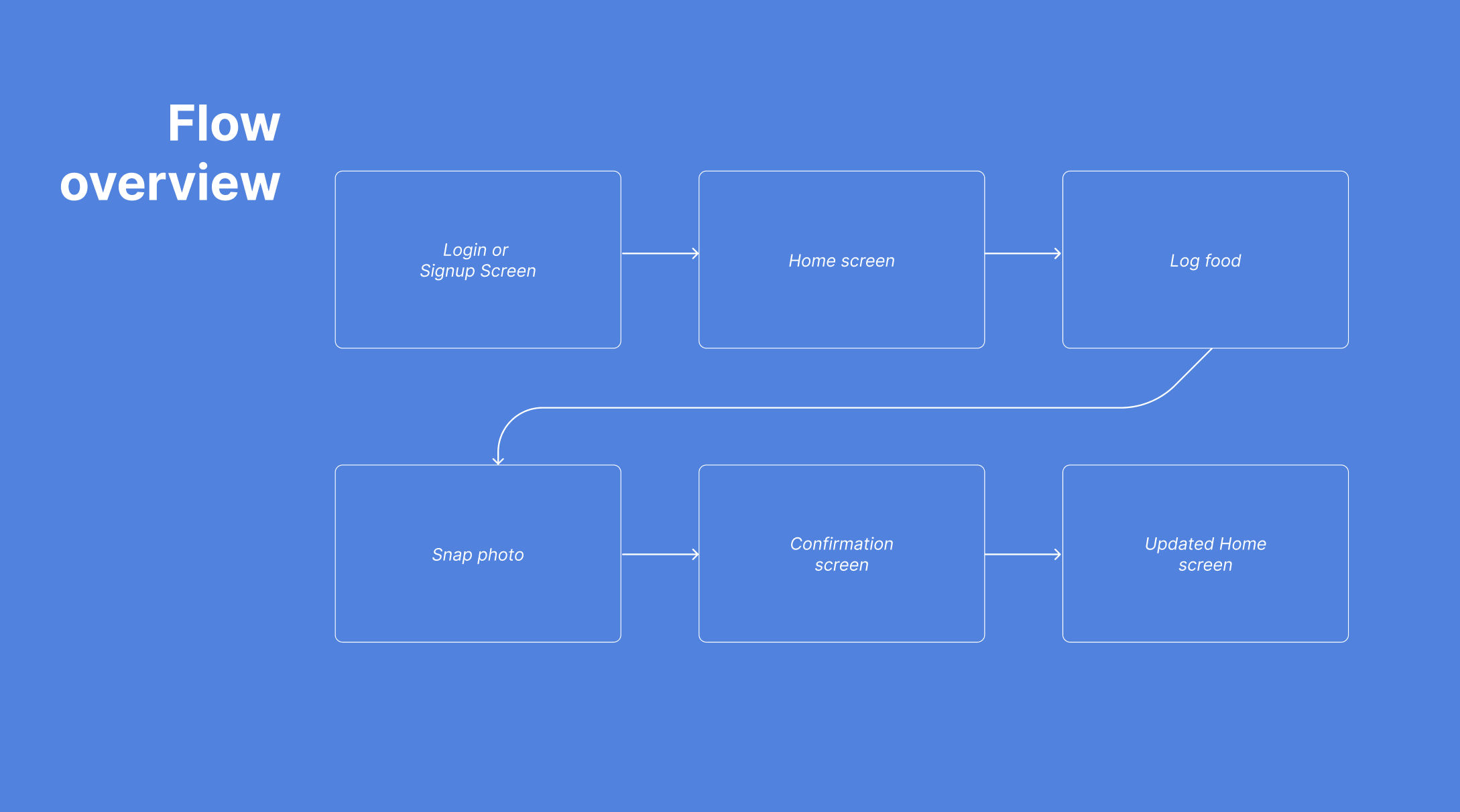
I explored solutions by starting with a high-level flow to define the simplest path from logging food to seeing updated progress. This helped identify where friction could occur and ensured the experience remained easy to repeat multiple times a day.
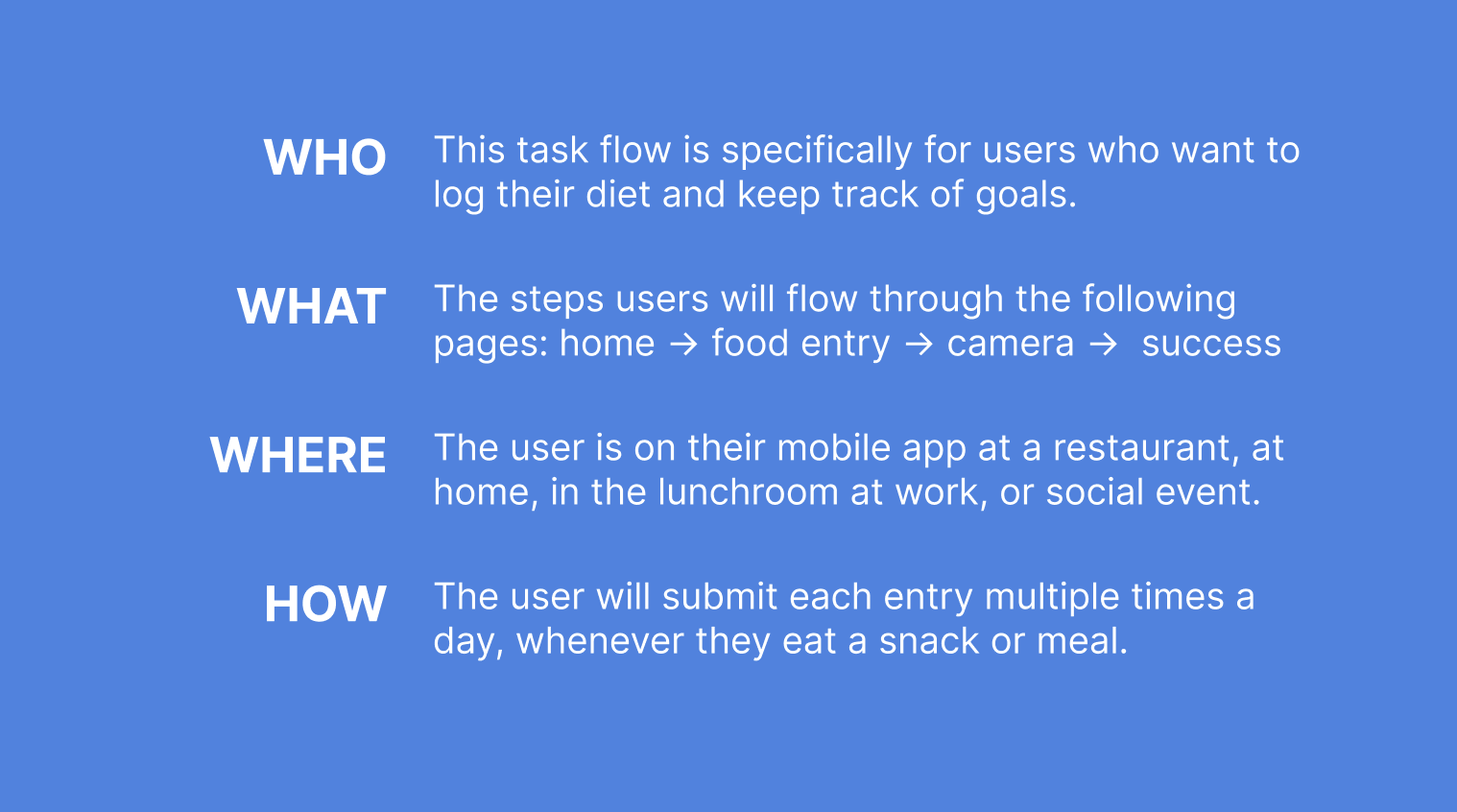
I then grounded the flow in real-world usage, recognizing that users log meals in fast, imperfect environments like restaurants, work lunchrooms, or social settings. This insight pushed the design toward speed and flexibility, and away from anything that required prolonged attention.
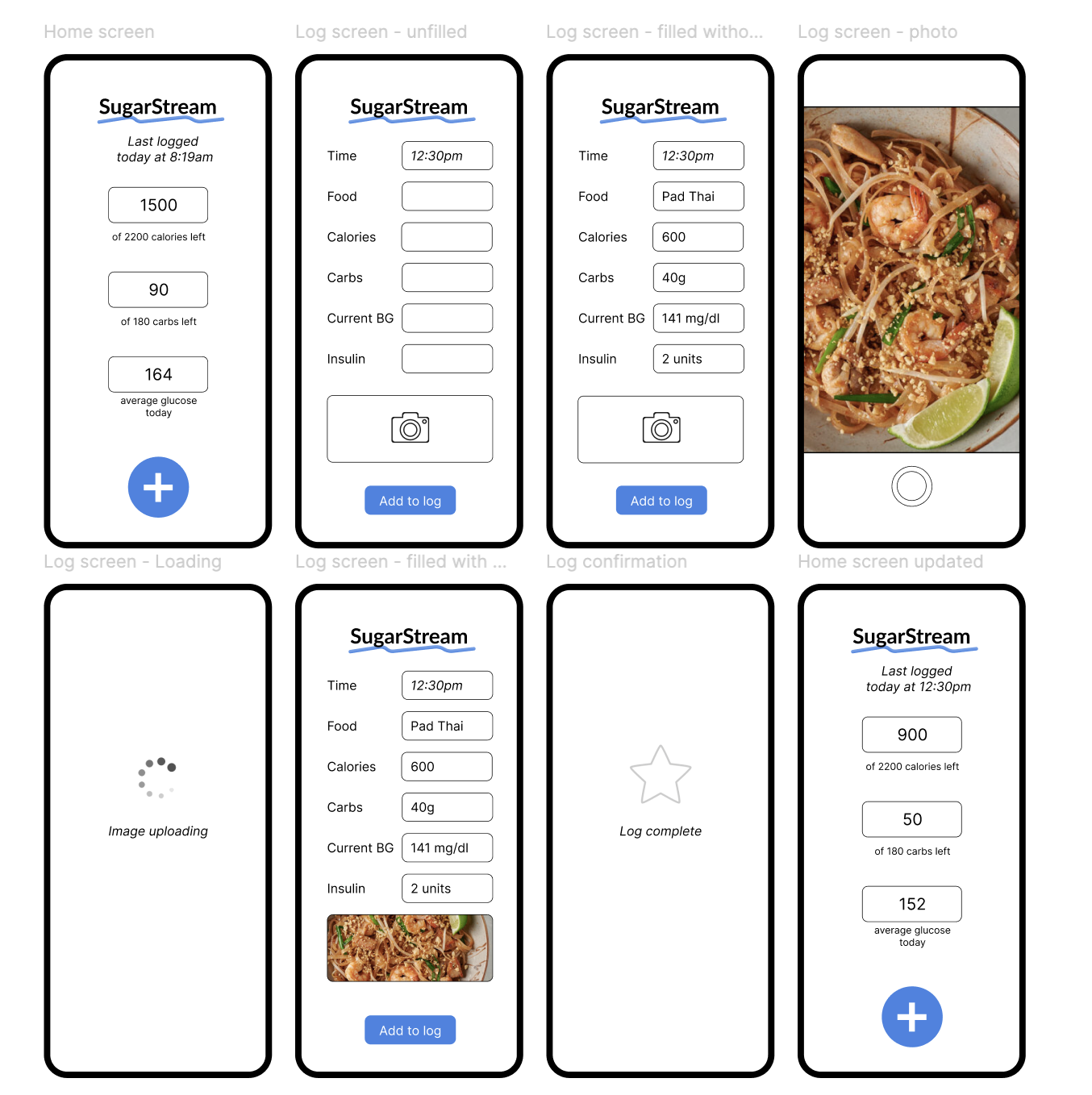
Using low-fidelity wireframes, I tested both manual and photo-based logging. Manual entry offered control but added too much effort, so it was deprioritized. The camera-based flow moved forward because it reduced cognitive load while still allowing users to confirm or edit entries.
Design Decisions
Throughout the process, simplicity guided decisions. Feature-heavy ideas were cut in favor of a focused, repeatable flow that made logging feel quick, intuitive, and sustainable. Every design decision started with a simple belief: if tracking feels heavy, people stop doing it.
Users do not need more data, they need consistency. Speed became the priority. Logging was designed to take seconds, not attention, because users are eating in the middle of real life, not in front of spreadsheets. Anything that slowed them down was removed. The camera became the primary entry point, not because it was novel, but because it is effortless. This single shift reduced friction and made consistency feel natural. A confirmation step remained by design. Automation without trust fails. Users needed a moment of clarity. A chance to say, “Yes, this is right,” without being pulled into complexity. Finally, the home screen responded instantly. Every action mattered, and users could see that immediately. Progress was not hidden in charts or menus. It was visible, reinforcing the habit with every log.
The result is a system that is easy to access and effective.
Prototyping & Testing
I validated the concepts through early feedback on low-fi prototypes, focusing on whether the experience felt fast, intuitive, and easy to repeat. Users responded positively to the camera-based logging flow, noting that it felt natural and removed the pressure of manual entry. This confirmed that reducing effort was the right direction.
Early iterations that had more detail or required additional steps that slowed users down or even broke the flow. Feedback made it clear that accuracy mattered, but not at the expense of speed. In response, the design was refined to keep a lightweight confirmation step while removing anything that felt optional or distracting. Each round of feedback helped sharpen the experience, ensuring the final direction balanced simplicity, trust, and consistency in a way users could realistically sustain.
Final Solution
The experience opens on a clear home screen that shows users their current progress at a glance. Logging a meal is designed to fit seamlessly into real life: users simply take a photo instead of typing or searching, making the action fast and intuitive wherever they are. A lightweight confirmation step provides confidence in accuracy without adding friction, and once confirmed, the home screen updates instantly to reflect progress. The result is an experience that stays out of the way, reinforcing consistency by making nutrition tracking feel effortless and repeatable.
Impact & Results
Explain what happened after launch. Include metrics, outcomes, or learnings, even if the results were mixed or incomplete. Lorem ipsum dolor sit amet, consectetur adipiscing elit, sed do eiusmod tempor incididunt ut labore et dolore magna aliqua. Ut enim ad minim veniam, quis nostrud exercitation ullamco laboris nisi ut aliquip ex ea commodo consequat. Duis aute irure dolor in reprehenderit in voluptate velit esse cillum dolore eu fugiat nulla pariatur. Excepteur sint occaecat cupidatat non proident, sunt in culpa qui officia deserunt mollit anim id est laborum.
Reflection & Learnings
If this project launched in the real world, I’d be interested learning whether the experience better matched users’ real-world habits and reduced friction in diet tracking. While the product remained at a prototype stage and measurable outcomes were stifled, both quantitative signals and qualitative feedback would have helped validate the direction.
Quantitative signals:
Faster average time to log a meal compared to manual entry flows
Higher completion rates for meal logging in usability testing
Increased frequency of logging during short-term testing sessions
Qualitative insights:
Users described the experience as “easy” and “natural” to use
The camera-based flow reduced the mental effort of logging
The confirmation step increased trust without slowing users down
Simplicity was cited as the primary reason users felt they could stay consistent
Together, these results confirmed that reducing friction was critical to adoption, while also highlighting opportunities to expand personalization and long-term engagement in future iterations.
What’s Next
Future iterations of this work would focus on expanding personalization and long-term habit support, particularly for users managing diabetes. There is a clear opportunity to integrate AI-driven insights, such as automatic meal recognition, sugar estimation, and contextual suggestions based on past behavior, to further reduce manual effort while maintaining trust and transparency. Testing these capabilities with diabetic participants would be essential to ensure accuracy, safety, and alignment with real clinical needs.